
Local leaders in Middletown Township have taken formal steps to overhaul the municipality’s public sign regulations, introducing a modernized legal framework that establishes strict placement timelines, dimensional caps, and fines of up to $500 per day for non-compliant displays.
The Board of Supervisors voted unanimously to advertise the updated ordinance, initiating a comprehensive policy shift designed to bring local municipal rules into strict compliance with federal constitutional law. The move requires the township to treat all categories of temporary signage under uniform standards, eliminating long-standing distinctions between commercial messaging and personal expression.
The legislative revision stems directly from a May 2024 decision issued by the U.S. Third District Court concerning sign policies in Camp Hill Borough. In that case, federal judges ruled that municipal governments across Pennsylvania cannot constitutionally enforce preferential standards that favor commercial advertisements or real estate signs over political messages and individual viewpoints.
In the Camp Hill case, local authorities had restricted personal expression displays to a maximum of two per property, while commercial promotions and holiday greetings were permitted to remain largely unrestricted. The federal court struck down this framework as a violation of First Amendment free speech protections, criticizing the municipality for constructing a disjointed and unequal system of speech enforcement.
To avoid similar constitutional challenges, Middletown’s newly proposed rules apply an across-the-board standard to every temporary placard. Whether an individual is advertising youth baseball registration, promoting a local power-washing company, hanging notices for holiday lighting installation services, or listing a home for sale, all temporary messages will now be governed by identical guidelines.
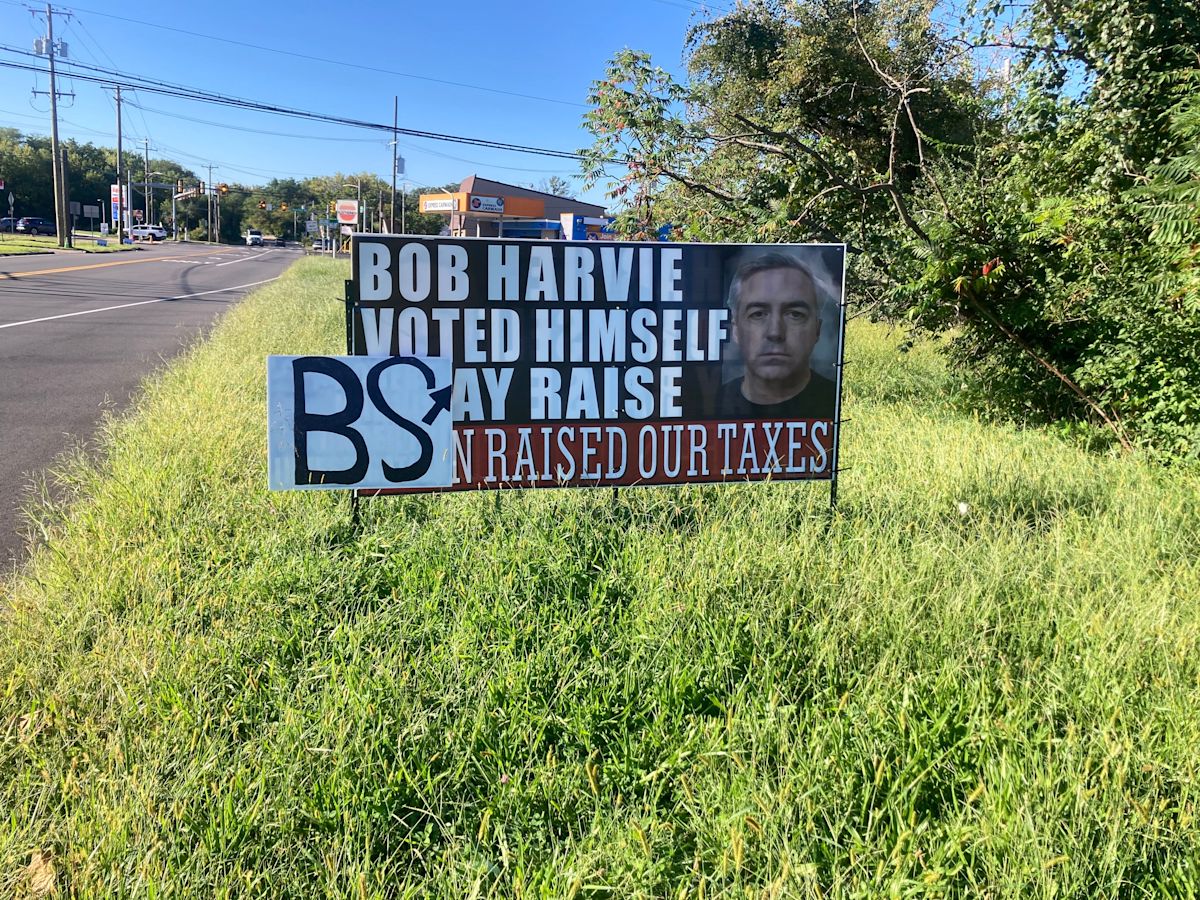
Political campaign messaging is expected to experience some of the most notable adjustments under the updated policy. The proposed ordinance explicitly states that campaign signs will not be permitted on display more than 30 days prior to an election date, and property owners will be required to remove all election-related signage within 10 days after voters cast their ballots.
Furthermore, the ordinance institutes a strict ban prohibiting all temporary signage within public rights-of-way, which typically run adjacent to busy municipal thoroughfares and major road corridors. The township will no longer allow any temporary display along these municipal corridors, regardless of whether the message is commercial, civic, or political in nature.
The restriction mirrors existing state policies established by the Pennsylvania Department of Transportation, which prohibit signs along state-maintained rights-of-way such as Bristol-Oxford Valley Road in Levittown. Although state-level right-of-way prohibitions have existed for many years, local officials noted that rigorous enforcement has historically been uncommon.
Addressing the logistical challenges of monitoring compliance, Township Solicitor Jim Esposito emphasized the scale of the community. As one of the largest municipalities in Bucks County, home to roughly 50,000 residents, Middletown does not possess the municipal resources to deploy dedicated crews tasked solely with patrolling roads for unauthorized signs.
Instead, the township plans to manage compliance through routine operations and resident reporting. Municipal road maintenance crews will be instructed to remove unlawful displays whenever they encounter them during their regular daily duties, and township staff will initiate targeted reviews whenever formal complaints are submitted by community members.
When violations are formally prosecuted before local district justices, offenders could face financial penalties reaching up to $500 per day for each non-compliant sign. However, township officials emphasized that they intend to prioritize voluntary compliance and exercise discretion before seeking severe judicial fines against community members.
According to Esposito, first-time offenders will typically be offered leniency and a chance to correct the violation without immediate financial penalty. Stiff financial consequences will be reserved primarily for persistent violators who continue to place unauthorized displays after being explicitly instructed by authorities to take them down.
The regulatory shift also addresses temporary signs situated on private properties, including residential front lawns displaying real estate notices or personal opinion statements. While the township plans to adopt a less intrusive enforcement approach for private lawns unless formal complaints arise, property owners must still adhere to mandatory size restrictions.
Under the dimensional guidelines set forth in the proposal, no single temporary sign may exceed a total surface area of 12 square feet. Additionally, the cumulative footprint of all temporary signs displayed on a single parcel cannot surpass an aggregate limit of 24 square feet, ensuring properties remain uncluttered regardless of the nature of the message.
By standardizing sign durations, dimensions, and public right-of-way restrictions, Middletown officials aim to safeguard local aesthetics and roadway safety while fully upholding federal constitutional standards for protected speech. The revised ordinance will proceed through the statutory public advertising process before returning to the supervisors for formal adoption.








(0)