
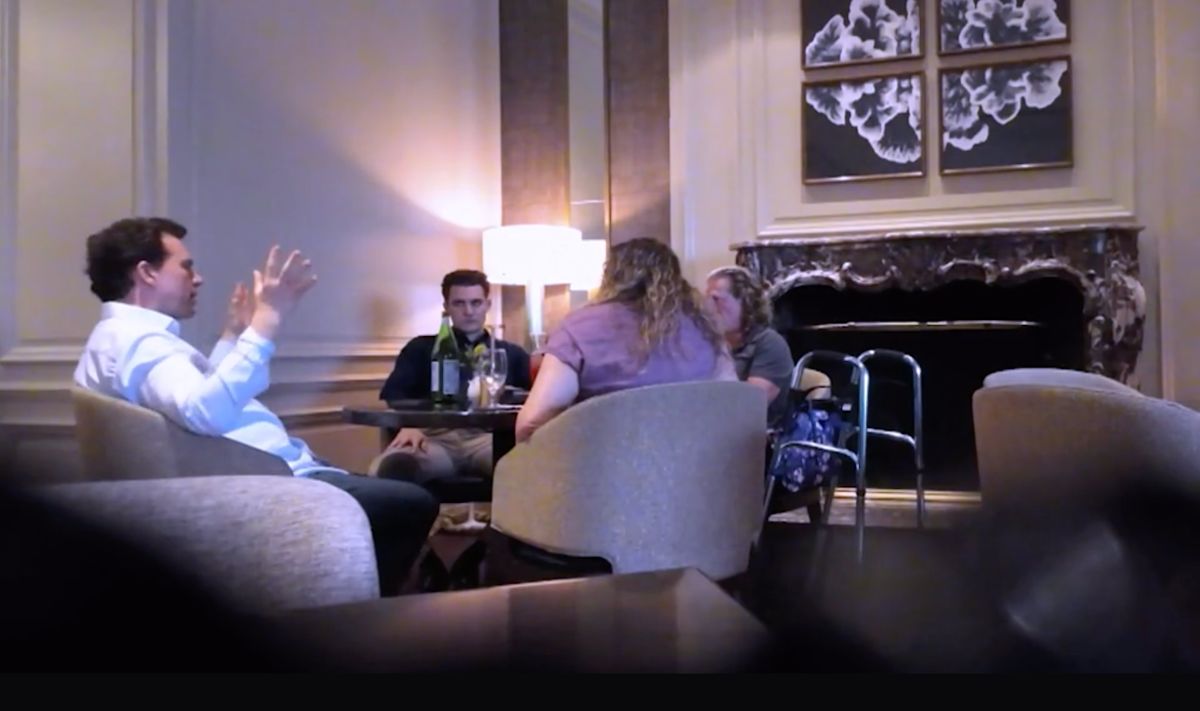
A covert investigation into the booming business of executive clemency has pulled back the curtain on how well-connected lobbyists and political operators pitch their access to the White House. Inside a plush hotel bar at the Ritz-Carlton in Tysons Corner, Virginia, just outside the nation's capital, conservative provocateurs Jack Burkman and Jacob Wohl laid out a lucrative proposition to a prospective client seeking presidential relief.
The pair believed they were securing business with Ammon Covino, an aquarium operator and convicted felon who attended the meeting alongside his wife, Crystal. In reality, the interaction was part of an undercover sting organized by CBS News' "60 Minutes," which equipped Covino with hidden cameras to document the shadowy mechanics of contemporary pardon brokering.
During the sit-down, Burkman detailed a strategy that bypassed conventional institutional channels in favor of aggressive lobbying. He told Covino that succeeding with this particular administration requires applying consistent, multi-directional pressure directly on President Trump to ultimately force his hand. Characterizing their approach as relying on contacts and aggressive energy rather than formal legal procedures, the brokers presented themselves as gatekeepers to executive power.
For their services, Burkman and Wohl quoted a price tag of $300,000, projecting they could deliver an official presidential pardon as early as October. What the brokers did not realize was that their sales pitch was being captured as evidence of a burgeoning, high-priced intermediary market operating around the White House.
Covino’s quest for clemency stemmed from a past conviction involving the illegal interstate transport of a stingray and a shark, a federal offense for which he served nearly two years in prison. Although he had previously submitted a formal application through traditional Department of Justice channels during the Biden administration, his request was officially turned down in July by Trump as part of a sweeping initiative to clear pending applicant backlogs.
The emergence of such lucrative intermediary operations mirrors a broader shift in how clemency has been handled over the past 18 months. Immediately upon taking office, Trump used his executive authority to clear more than 1,500 individuals charged or convicted in connection with the Jan. 6 Capitol riot through dropped prosecutions, commutations, and pardons. In the months that followed, dozens of additional clemency grants were awarded to white-collar offenders who were often wealthy and politically connected.
Historically, the traditional clemency pipeline depended on an extensive review by more than two dozen Department of Justice attorneys. Those career lawyers systematically evaluated formal petitions, weighing factors such as an applicant's remorse and demonstrable signs of societal rehabilitation before making recommendations to the president.
Under the current administration, that structured review mechanism has been largely marginalized. According to an analysis of Justice Department data conducted by CBS News, approximately 70 percent of Trump's second-term clemency grants bypassed the DOJ process entirely. When factoring in the sweeping Jan. 6 clemency actions, that figure rises to 92 percent.
In place of traditional bureaucratic vetting, a lucrative pardon economy has flourished across Washington. Pardon brokers now market their personal connections, enlist the aid of MAGA influencers, and coordinate with figures close to the president to capture the administration's attention. With personal access serving as the principal currency, some operatives demand fees reaching as high as $3 million to advance a petitioner's case.
Controversial pardons are not entirely unprecedented in American history, as past commanders in chief have regularly broken with established norms. President Gerald Ford famously pardoned Richard Nixon, while President Jimmy Carter granted broad clemency to Vietnam War draft evaders. On his final day in the White House, President Bill Clinton drew intense scrutiny for pardoning fugitive financier Marc Rich, whose spouse, Denise Rich, had been a prominent financial contributor to Clinton's presidential library foundation.
More recently, President Joe Biden faced sharp criticism in December 2024 for issuing a series of eleventh-hour clemency actions to family members, donors, and political allies. Among those granted relief were his son, Hunter Biden—who had faced federal firearms convictions and entered a guilty plea to tax evasion charges—along with a preemptive pardon for Dr. Anthony Fauci.
Nevertheless, legal experts, defense lawyers, and federal prosecutors argue that the current clemency landscape is unprecedented in its scale and commercialization. The system has transformed into what many describe as an unregulated Wild West, where customary standards of merit, contrition, and institutional review have been largely cast aside in favor of money and influence.
This pay-to-play environment has drawn fierce criticism from legal scholars who advocate for fair access to the justice system. Mark Osler, a law professor at the University of St. Thomas in Minnesota who directs a pro bono clemency clinic for federal convicts, warned that a constitutional mechanism designed to provide equitable mercy is being distorted.
Osler noted that the system was originally intended to be freely accessible to any deserving applicant, regardless of wealth. Instead, an entire commercial sector has emerged, convincing clemency-seekers that their only realistic path to relief is spending hundreds of thousands, or even millions, of dollars to purchase access to high-profile associates and White House insiders.









(0)