
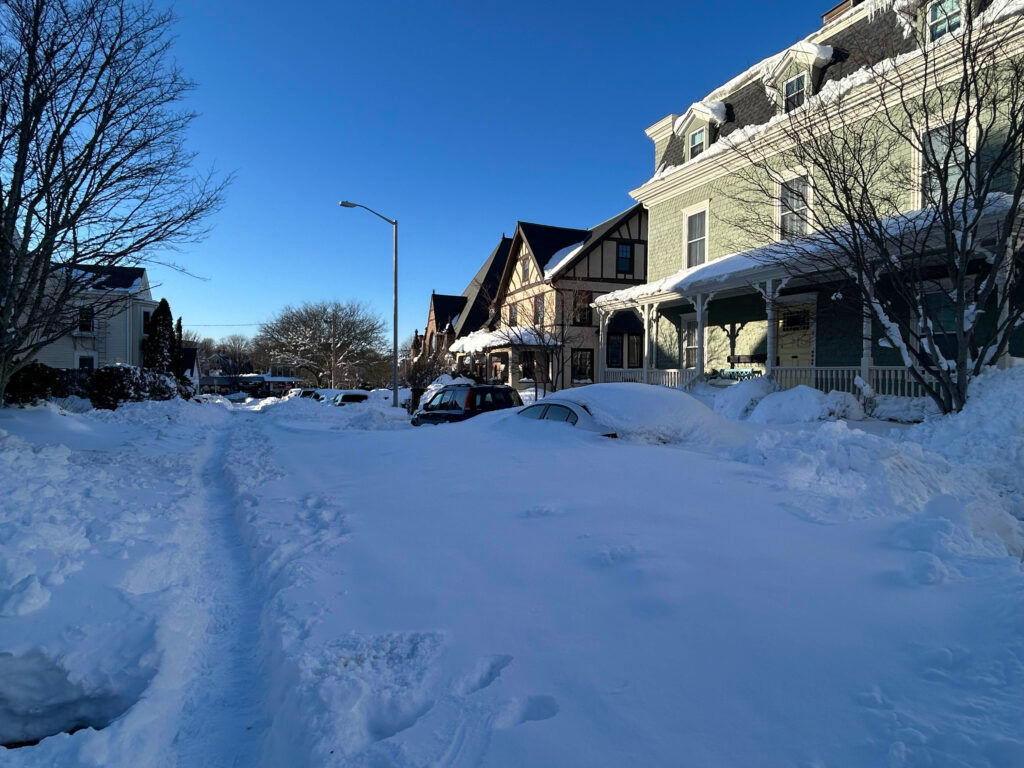
Members of Rhode Island’s congressional delegation are mounting an aggressive push against the Trump administration following the Federal Emergency Management Agency’s repeated refusal to grant federal disaster relief for a devastating blizzard that crippled the state in February 2026.
In a formal letter sent on Sept. 9, U.S. Senators Jack Reed and Sheldon Whitehouse, together with U.S. Representatives Seth Magaziner and Gabe Amo, called upon the Department of Homeland Security and its sub-agency, FEMA, to preserve and immediately disclose all internal communications and records concerning the state's rejected disaster declaration request.
The federal lawmakers underscored that the emergency relief agency has failed to provide Rhode Island officials with any comprehensive written rationale explaining why financial relief was withheld. This lack of transparency has sparked strong pushback from the delegation, which maintains that the financial damages caused by the storm comfortably exceeded the established federal thresholds required for major disaster assistance.
The dispute stems from an official request submitted on April 7 by Rhode Island Governor Dan McKee. Invoking the Stafford Disaster Relief and Emergency Assistance Act, McKee sought $19 million in federal aid to help the state recover from the catastrophic winter storm, noting that the severe weather created conditions extending far beyond the state's independent capabilities.
The state's formal petition was met with resistance from federal authorities from the outset. FEMA issued an initial rejection of Rhode Island's disaster declaration on July 2, prompting state leadership to file an appeal. That appeal was subsequently turned down by the agency on Sept. 2.
Following the second rejection, Governor McKee publicly condemned the federal government's stance, characterizing FEMA’s refusal to deliver critical blizzard recovery funding to Rhode Island communities as a new low in disaster response cooperation.
Throughout the administrative process, federal officials provided minimal justification for the denial. In both the initial determination and the subsequent appeal rejection, FEMA leadership utilized boilerplate language, stating only that a review of available information indicated supplemental federal assistance was not warranted under the Stafford Act.
Public remarks from leadership further intensified the controversy when FEMA Administrator Cameron Hamilton took to social media platform X on Sept. 3 to defend the decision. Hamilton asserted that the affected jurisdictions failed to submit new details for evaluation and remarked that winter weather is not new to the Northeast.
Rhode Island was not the only jurisdiction to receive such denials. The federal agency applied the same reasoning to reject comparable disaster assistance requests submitted by neighboring state governments across the region, including Massachusetts, New York, and New Jersey.
Members of the Rhode Island delegation forcefully rejected the administrator's characterization of the storm, asserting that the extreme event was anything but ordinary winter conditions. Lawmakers noted that downplaying the unprecedented severe weather minimizes the widespread destruction experienced across the state.
Meteorological records show that the February 2026 blizzard was one of the most intense storms in Rhode Island's recorded history. When the system struck on Monday, Feb. 23, it dumped more than three feet of snow across several municipalities, with Rhode Island T.F. Green International Airport logging an extraordinary 37.9 inches of accumulation, surpassing the benchmark 28.6 inches recorded during the historic Blizzard of 1978.
Beyond record-breaking snowfall, the storm generated wind gusts reaching 74 mph, matching the strength of a Category 2 hurricane. The severe weather battered infrastructure, leaving thousands of homes without electricity and creating severe logistical challenges for municipal road crews and emergency personnel.
The financial toll of the storm reached approximately $19 million statewide in cleanup expenditures and infrastructure damages. Of that total, roughly $9 million represented direct state costs, while the remaining $10 million was shouldered by individual cities and towns struggling to clear snow-covered streets and repair local facilities.
The congressional delegation argued that dismissing the destructive impacts as routine seasonal weather represents a profound insult to local residents and business owners whose livelihoods were severely disrupted by the massive snowstorm.
Lawmakers emphasized that a thorough examination of internal agency records is essential to understand how FEMA reached its conclusions and to evaluate whether Hamilton's public explanations align with the agency's actual administrative files. They warned that failing to maintain and deliver the requested records would lead to the reasonable conclusion that the government's justification is entirely baseless.
When pressed for comment on the congressional inquiry, representatives from both FEMA and the Department of Homeland Security reiterated the agency's original position, maintaining that the states requesting blizzard relief had submitted no new information to justify overturning the denial.






(0)