
Lawmakers in Renton are scheduled to vote Monday on a proposed measure that would prohibit public camping across municipal properties. The upcoming decision could position the city as the newest Western Washington municipality to enact stringent restrictions on outdoor encampments following shifts in legal precedent surrounding municipal authority over public spaces.
The legislative initiative comes in the wake of a landmark ruling by the United States Supreme Court, which clarified that local camping bans do not violate the Eighth Amendment’s constitutional protections against cruel and unusual punishment. That judicial determination has paved the way for local governments across the region to reevaluate and overhaul their public space policies.
Multiple neighboring jurisdictions in Washington state have already moved forward with comparable regulations. Municipalities including Lakewood, Tukwila, and Burien have established their own local prohibitions in the period following the Supreme Court's constitutional interpretation, establishing a growing regional pattern of municipal enforcement.
Under the regulatory framework being considered by the Renton City Council, individuals would be barred from pitching tents or securing protective tarps on any property owned or managed by the city. The prohibited areas encompass a wide variety of public facilities and recreational grounds, extending explicitly to municipal parking lots, pedestrian walking trails, and public parks.
In addition to restricting makeshift shelters, the proposed ordinance places strict limitations on associated activities and personal property. Under the language of the draft law, members of the public are forbidden from kindling fires, storing personal items, or leaving shopping carts unattended on municipal grounds.
The ordinance also seeks to establish designated trespassing zones across city properties. This framework provides law enforcement and municipal staff with a formal legal structure to warn individuals and clear unauthorized belongings from public grounds when compliance is not voluntarily achieved.
For individuals who repeatedly violate the regulations after receiving warnings or entering designated exclusion zones, the measure establishes criminal penalties. Repeat infractions can be prosecuted as misdemeanor offenses, which carry potential legal repercussions of up to 90 days in jail and financial penalties reaching as high as a $1,000 fine.
Despite the inclusion of criminal penalties, the draft legislation mandates that municipal authorities and service providers offer outreach assistance to unhoused individuals encountered on public property. The goal of this provision is to ensure that vulnerable people are extended opportunities to access social services alongside enforcement efforts.
The dual focus on enforcement and service delivery has drawn support from community advocates who argue that municipal policy must address public order while aiding individuals in crisis. Max Komar, representing the non-profit organization Battlefield Addiction, noted that public policy must seek an equilibrium between enforcing community standards and offering essential aid.
Komar’s organization works directly with individuals confronting substance abuse issues, many of whom reside in unsanctioned outdoor encampments. He emphasized that addressing the issue requires considering the wellbeing and security of broader residential neighborhoods alongside the needs of those experiencing homelessness.
According to Komar, local families have a right to feel secure in their neighborhoods. He expressed support for balanced local policies designed to protect communities from public drug consumption and hazardous encampments, while concurrently guiding displaced individuals toward legitimate support networks and resources.
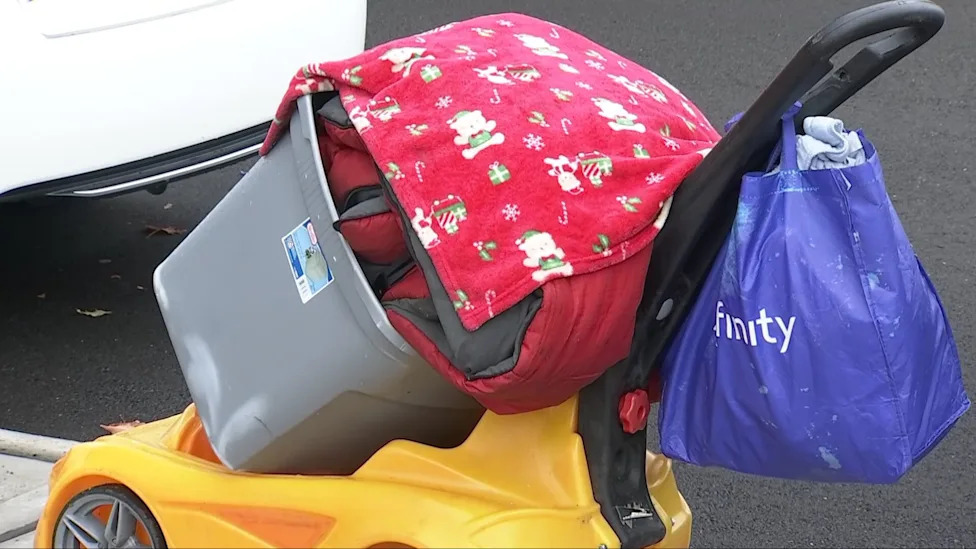
Conversely, the pending measure poses substantial challenges for unhoused residents currently living in public areas throughout Renton. Among those affected is Nicole, an unhoused woman who navigates downtown Renton carrying her remaining belongings on a child’s push car.
Nicole explained that she has experienced homelessness for roughly three to four years after losing all of her possessions. Her typical routine involves seeking overnight shelter in public parking lots, locations that would become strictly off-limits should the City Council approve the pending ban.
For Nicole and others in similar circumstances, entering traditional emergency shelters remains an unacceptable option. She expressed deep mistrust regarding the environment within shelter facilities, describing them as unhealthy and unreliable, and stated that she strongly prefers staying on the street over moving into a congregate facility.
With public parking lots and sidewalks slated to become restricted zones under the proposed law, unhoused individuals who decline traditional shelter options will face dwindling alternatives. The prospect of misdemeanor charges and potential fines introduces further complications for those with limited financial means and nowhere else to store their property.
The Renton City Council's scheduled vote on Monday will determine whether the city joins its regional neighbors in adopting formal camping prohibitions, officially reshaping how local officials manage public lands, social service outreach, and unauthorized encampments within municipal limits.





(0)