
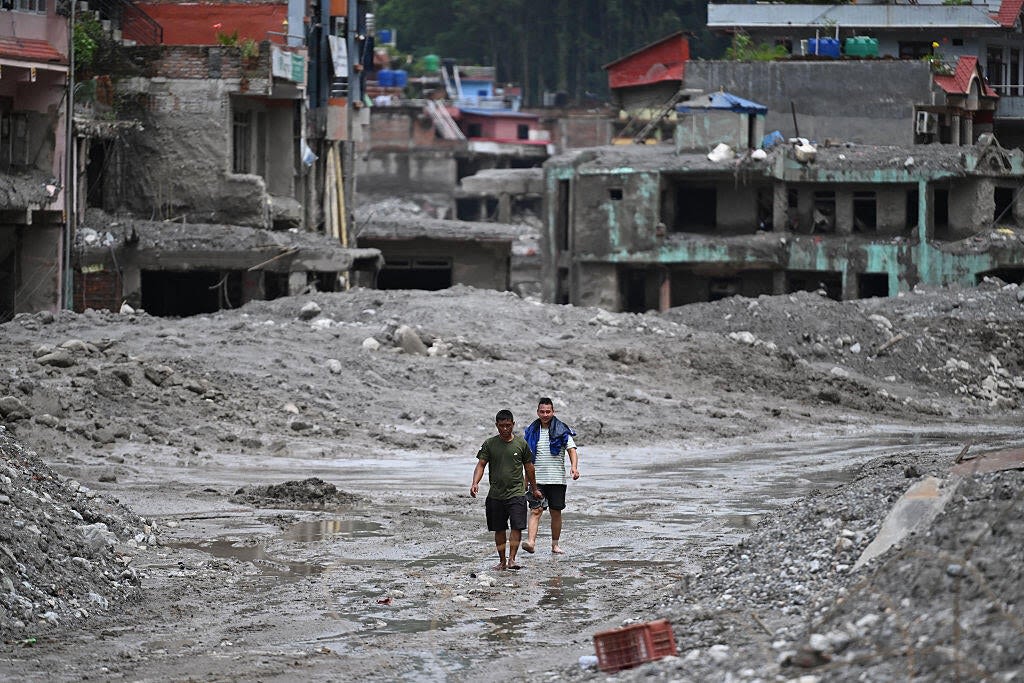
KATHMANDU, Nepal – The situation in Nepal remains critical as the death toll from the recent catastrophic floods has now exceeded 900, with over 4,200 people reported missing. As the country grapples with the aftermath, authorities have issued fresh flood warnings, urging residents to remain on high alert.
The National Disaster Risk Reduction and Management Authority of Nepal reported that the death toll has climbed to 903, with 4,247 still missing. Across the border in China, authorities have reported 16 deaths and 546 missing. The warnings come after the Bhotekoshi River experienced a significant rise in water levels, prompting the emergency notifications.
Survivors in the flood-affected districts are struggling to come to terms with the devastating loss. Govind Shreshta, a resident of a flood-hit village, described the constant alarms and the difficulty of carrying his elderly parents to higher ground during the night. "It's really difficult for me," he said. "I have a 72-year-old father and 70-year-old mom. I must carry them and I am exhausted."
In Dhading, one of the worst-hit regions, some residents have begun returning to their homes to see what can be salvaged. Sharmila Tamang, a resident of Dhading, expressed the overwhelming sense of loss, "Everything is finished. Nothing is left. Not even our home."
The floodwaters have caused severe damage to infrastructure, including a key power plant that serves over 20,000 people across four districts. Workers began inspecting the facilities on Sunday to assess the extent of the destruction.
The U.S. State Department has confirmed that there are currently 85 Americans unaccounted for in Nepal, with nine having been safely evacuated. Tommy Pigott, a U.S. State Department spokesperson, said the department has activated $3.6 million in emergency humanitarian assistance, including food for up to 10,000 households.
The missing also include hundreds of people from over a dozen countries who were in the region to work, visit the mountains, or make a pilgrimage to a sacred peak. Chinese state media reported that 261 foreigners are missing in Tibet, including over a hundred Nepalis and others from around the world.
The floods began after a glacial collapse high in the Himalayan region. Scientists who analyzed satellite images said the bedrock underneath a glacier had collapsed, taking part of the glacier with it. The extreme rockfall registered as a magnitude 5.2 earthquake, which then caused a torrent of water to sweep downstream, destroying buildings, bridges, and land in both Tibet and Nepal.
Nepal's foreign minister has called for a global response to climate change, emphasizing that the country is bearing a disproportionate share of its impact. The disaster has underscored the urgency of addressing the effects of climate change and the need for international cooperation to mitigate such events in the future.







(0)