
A massive maritime search and rescue operation is currently underway across Indonesia's Java Sea after a commercial passenger ferry overturned in severe weather, leaving an estimated 130 people missing. Emergency response teams and maritime authorities are mobilizing significant resources to comb through vast expanses of open water in a critical effort to locate survivors from the disaster.
The stricken vessel, identified as the Virgo Transport 8, was transporting more than 240 passengers and crew members when the catastrophe occurred. The ferry had originally embarked on its scheduled voyage from the port city of Surabaya in East Java and was heading northward toward Banjarmasin, a major port located in South Kalimantan province on the island of Borneo.
According to updates provided by emergency responders, at least 107 people have been safely pulled from the sea so far, receiving urgent care and evaluation. However, the tragedy has already claimed lives, with recovery teams retrieving the bodies of six deceased passengers as the operational search grid continues to expand outward from the vessel's last known coordinates.
Harsh meteorological conditions and turbulent waters appear to have played a central role in precipitating the disaster. Before contact was lost, the vessel's captain issued reports detailing dangerously rough sea conditions, specifically warning that towering waves had reached heights of up to 10 feet in the area.
I Putu Sudayana, who oversees operations as head of the Banjarmasin Search and Rescue Office, explained that the captain transmitted an urgent distress call indicating that the ship had begun listing severely under the impact of the powerful waves. Shortly after this emergency notification, authorities received confirmation that the unstable vessel had completely capsized in the open sea.
The timeline provided by emergency agencies indicates that formal distress alerts reached the regional rescue headquarters in Banjarmasin approximately two hours after all radio and tracking contact with the Virgo Transport 8 abruptly ceased at around 2:00 a.m. on Sunday.
To respond to the crisis with maximum urgency, Indonesian authorities launched a major multi-agency operation by Sunday afternoon. The search fleet grew to encompass teams deployed aboard eight different marine vessels—including four dedicated naval warships—alongside two surveillance helicopters conducting low-altitude aerial sweeps over the water.
Initial navigational reports placed the ferry's last recorded position in the Java Sea, roughly 92 miles away from its intended destination at the port of Banjarmasin. The considerable distance from the coastline has compounded the difficulty of search efforts across a wide and challenging marine corridor.
The official manifest documented that 243 individuals were aboard the ship for the crossing, comprising 213 ticketed passengers and a 30-member crew. In addition to carrying people across the maritime corridor between Java and Borneo, the vessel was also loaded with 89 vehicles on its cargo deck.
Despite the figures registered on the manifest, authorities noted that it is relatively common across Indonesia for the actual number of people traveling on passenger vessels to deviate from official documentation. Such recurring record discrepancies present an ongoing challenge for rescue personnel attempting to confirm the exact count of missing travelers and survivors.
Addressing reporters during an operational briefing on Sunday, Transportation Minister Dudy Purwagandhi clarified that aerial surveillance confirmed the capsized ferry remained floating upside down rather than plunging directly to the seabed.
Minister Purwagandhi explained that because the hull continues to drift inverted on the surface, search and rescue personnel are concentrating their primary tactical efforts in the direct vicinity surrounding the overturned ferry to locate anyone who may be adrift nearby.
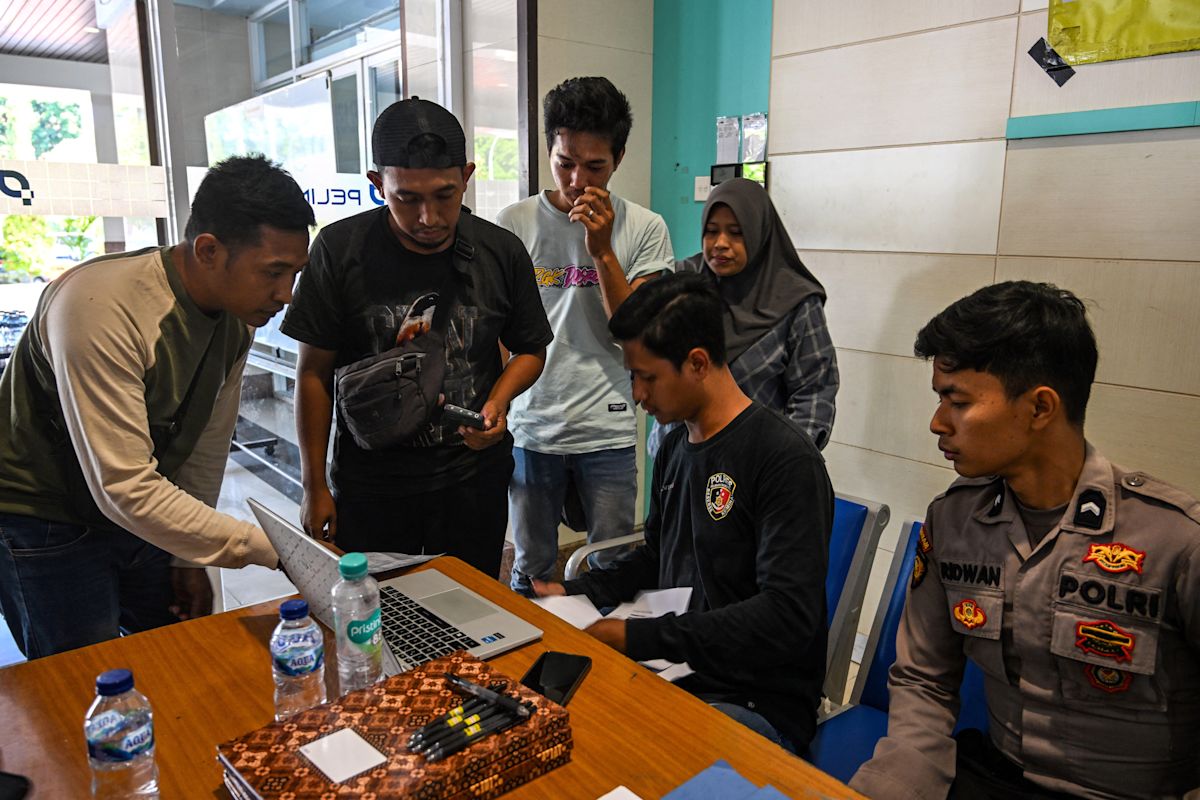
On land, scenes of deep anguish unfolded as hundreds of concerned relatives gathered at a command post established at Trisakti Bandarmasih Port in Banjarmasin. Anxious families spent hours waiting for verified updates regarding the status of loved ones believed to have been on board the ill-fated crossing.
Relatives crowded around official bulletin boards to inspect passenger manifests and newly released rescue rosters for any sign of their family members. One woman, who goes by the single name Bunga, described the emotional turmoil of the ordeal, noting that she was initially terrified to discover her uncle's name on the manifest, but felt immense relief after authorities confirmed he was among the 107 survivors rescued.
The capsizing underscores the structural realities and hazards of inter-island transport in Indonesia. Spanning an expansive archipelago of more than 17,000 islands, the nation relies heavily on ferry networks as an indispensable mode of transportation for domestic travel, trade, and commuting between distant provinces.
However, the country's vast maritime transport sector is frequently marred by recurring accidents and deadly sinkings. Maritime disasters remain a regular challenge in Indonesian waters, where difficult oceanic conditions often intersect with weak enforcement of essential safety regulations and navigational standards.








(0)