
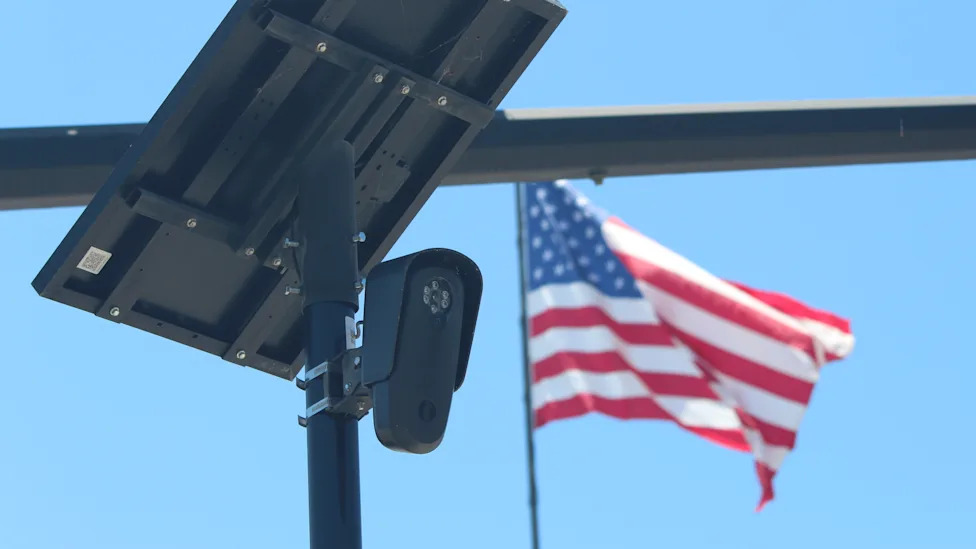
Law enforcement agencies across the Miami Valley in southwestern Ohio are actively investigating a series of vandalism incidents targeting Flock automated license plate reader cameras. The destruction of the surveillance hardware comes amid an intensifying statewide debate over digital privacy, police oversight, and the rapid expansion of automated tracking networks.
The targeted attacks have disrupted monitoring equipment in multiple neighboring jurisdictions. In the community of Riverside, a camera installed within a military housing development was forcefully torn from its mounting pole, leaving the device hanging exposed by its electrical wiring.
Only a short distance away, another camera unit located along Kauffmann Road was targeted in a deliberate act of protest. Perpetrators coated the camera lens in paint to disable its scanning capability and defaced the mounting structure by scrawling the words "No Flock" directly onto the pole.
Officers from the Fairborn Police Department have launched an active investigation into the property destruction. Investigators are working to identify the individuals responsible for disabling the municipal surveillance hardware across the affected areas.
The destructive acts have drawn sharp criticism from local residents who believe property damage is the wrong method to express opposition to police surveillance. David Lutzweit, a resident of Riverside, strongly condemned the attacks, characterizing the destruction as criminal behavior that undermines legitimate civic discourse.
Lutzweit emphasized that citizens who harbor concerns about government surveillance should rely on established democratic channels rather than taking destructive matters into their own hands. He noted that residents who object to the camera systems should attend local council meetings, voice their grievances to elected leaders, and participate in official public forums.
While acknowledging public unease, Lutzweit also defended the practical value of automated license plate readers, highlighting their proven track record in assisting regional law enforcement. He stated that the technology represents a vital asset for investigators, emphasizing that the devices have played a direct role in solving numerous criminal cases throughout the region.
The unrest in Ohio highlights the complex national conversation surrounding Flock Safety, whose specialized license plate reading systems have expanded at an unprecedented pace. The company's technology is currently operational in more than 6,000 communities spanning every U.S. state with the sole exception of Alaska.
Despite their widespread adoption by law enforcement agencies, the automated cameras have faced increasing scrutiny from privacy advocates and political figures. The growing unease has reached the state level, where candidates campaigning for Ohio governor are now urging the implementation of strict new statutory safeguards to regulate how license plate data is collected and retained.
Concerns regarding public privacy and data mismanagement have already led some local governments to scale back their reliance on the technology. Notably, the city of Dayton decided to dismantle and remove its entire municipal network of Flock cameras earlier this year following community pushback and official reviews of system misuse.
The decision to abandon the program in Dayton followed high-profile controversies involving internal system non-compliance. In one significant incident, a Dayton police officer resigned from the force after an internal affairs investigation revealed that the officer had failed to comply with strict departmental protocols while operating the camera system.
Notwithstanding these administrative and privacy challenges, high-ranking state officials continue to champion the public safety benefits of the automated detection network. During a law enforcement symposium held in Dayton on Monday, Ohio Attorney General Andy Wilson delivered remarks praising the investigative and lifesaving capabilities of the system.
To demonstrate the concrete benefits of the monitoring network, Attorney General Wilson pointed to a recent successful emergency response operation in Miami County. In that case, law enforcement officers were able to utilize real-time automated camera alerts to swiftly locate and rescue a suicidal man in critical danger.
The tension between technological efficiency in public safety and the protection of constitutional civil liberties continues to generate friction among residents and policymakers alike. As unauthorized database searches and procedural violations draw scrutiny in various jurisdictions, public skepticism toward mass surveillance infrastructure remains elevated.
Flock Safety has issued a formal statement condemning the recent wave of equipment destruction in the Miami Valley. A corporate spokesperson stated that vandalizing and disabling the monitoring devices does not solve policy disagreements and ultimately jeopardizes the safety of the very communities the technology is deployed to protect.






(0)